
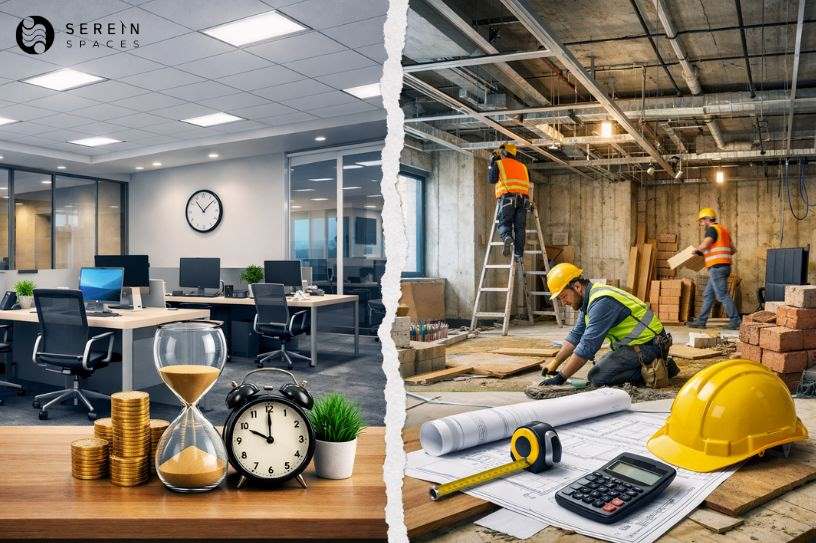
The biggest mistake in office interiors isn’t always overspending. Actually, it’s assuming the quoted cost and timeline will remain unchanged once execution begins.
On paper, everything seems controlled. You have a defined layout, a clear office fit-out cost estimation, and vendors ready to start. However, when your project moves forward, dependencies also kick in. One delay affects another task. A small change has the potential to trigger rework. Coordination between office interior contractor services starts consuming time, and gradually, your office interior project cost gets away from what was initially planned.
This isn't an exception; it’s exactly a pattern that is tied to how the project is structured. That’s exactly why the discussion around turnkey office interior vs contractor matters. In this guide, you’ll explore a practical breakdown of both approaches, so that you can make a decision based on how projects actually run, not just how they’re being presented at the start.
Understanding Turnkey Office Interior Solutions
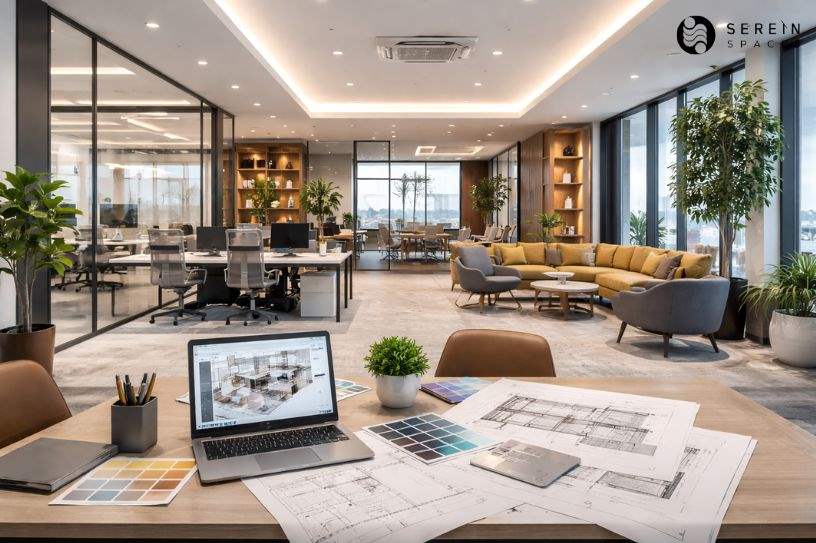
A turnkey office interior solution truly brings design and execution under just one responsible team. They eliminate the need to handle several office interior contract services. Their goal is just simple: deliver a ready to use workspace without any fragmented coordination while incorporating modern office interior design ideas that improve functionality and efficiency.
It begins with office space planning and design,with a strong focus on execution feasibility. Actually, a practical cost estimation is built alongside the design, and helps control the overall cost from the beginning.
When the project moves forward, then procurement, scheduling, and on-site work are handled through structured management, keeping timelines aligned and reducing delays.
Key Features of Turnkey Services
-
Single Point of Responsibility: One takes complete responsibility from the design phase to delivery.
-
Aligned Design and Execution: Their plans are prepared with real-world feasibility, and they reduce rework and cost variations.
-
Defined Pricing Structure: Transparent office interior design pricing always helps maintain budget control.
-
Consistent Quality Control: They supervise the work, and their centralized supervision ensures uniform standards, especially important in premium office interior design projects.
-
Reduced Coordination Effort: No need to manage several commercial office contractors or vendors.
What is a Traditional Contractor Model?

This model divides an office interior project across multiple teams. Generally, a designer manages the concept, while contractor services take care of execution, materials, along with installations. Rather than just one accountable partner, the project runs through various vendors working within their own scope.
This setup provides you with flexibility, but your coordination will become critical. Precisely managing timelines, vendor dependencies, along with quality mostly needs constant involvement, and the actual cost can be shifted from the initial ones.
Key Features of Contractor Approach
-
Multiple Vendors Involved
Here, your project is handled by separate contractors, who manage the different parts of the project.
-
Design and Execution are Separate
Gaps can emerge between planning and on-site work.
-
Flexible Vendor Selection
You get flexibility to choose or sometimes change contractors.
-
Variable Cost Structure
Pricing can be varied during execution.
-
Higher Coordination Effort
Continuous involvement needed in order to manage vendors and timelines.
-
Dependent Timelines
Delays in one stage badly affect the overall office renovation cost and timeline.
Turnkey Office Interior vs Contractor: Detailed Comparison
| Factor | Turnkey Office Interior | Contractor Model |
|---|---|---|
| Cost Comparison | More controlled and predictable due to defined scope and aligned execution | Costs may increase during execution due to changes, delays, or coordination gaps |
| Time & Project Completion | Structured workflow allows faster and more reliable completion | Sequential work leads to delays if one stage is held up |
| Quality & Consistency | Consistent output as one team manages the entire process | Quality may vary across different vendors |
| Project Management Effort | Minimal involvement needed with centralized handling | Requires continuous coordination and supervision |
| Flexibility & Customization | Customization available within a structured process | Greater flexibility to choose vendors and materials at each stage |
| Risk & Accountability | Clear accountability with one responsible team | Shared responsibility, making issue resolution more complex |
Pros and Cons of Turnkey Office Interior
Advantages
-
CLARITY AND CONTROL
A turnkey approach is specially designed for situations where clarity and control really matter more than anything else. In this approach, the biggest strength is consistency. Since one team manages everything from planning to execution, decisions remain properly aligned throughout the project, which reduces confusion and avoids any mistakes.
-
EASE OF MANAGEMENT
Another clear advantage is ease of management. You really don’t need to chase multiple vendors or even coordinate different designers, contractors, along with suppliers. Almost all operational burden sits with one team, and makes the entire process far more manageable, especially during execution-heavy phases.
-
PREDICTABILITY
Furthermore, it brings better predictability. When responsibilities are unified, then there’s less space for miscommunication, which often means fewer unexpected changes during the build stage.
Disadvantages
-
COST PERCEPTION
Another point is cost perception at the beginning. The initial quote may feel higher compared to piecemeal execution, even though it often balances out when delays and coordination issues are considered.
Pros and Cons of Contractor Approach
Advantages
-
FREEDOM
This model provides you with more freedom at each stage of the project. You can select different specialists for different types of work, compare options, and then make decisions according to price or expertise. For businesses that want strict control over individual components, this flexibility can be useful.
-
CUSTOMIZATION
It also enables more customization during execution. Since each part of the project is managed separately, there’s room in order to adjust vendors or even materials on dynamic requirements.
Disadvantages
-
COORDINATION
The biggest challenge is coordination. When multiple parties are involved, keeping everyone aligned becomes an ongoing responsibility. Even small gaps in communication can affect progress or lead to rework.
Which Option is Better for Your Business?
The smart choice always depends less on the model itself. It depends more on how exactly your business prefers to handle execution, coordination, and decision-making during the project.
Some setups need perfect speed and better structure. Whereas others can afford even more flexibility and hands-on control. The right fit is actually the one that reduces stress on your team and then keeps the project moving without any constant intervention.
Choose Turnkey If:
-
You really want a single team to handle everything from planning to the delivery phase.
-
Time is limited for you to coordinate with multiple vendors.
-
You need a clear, predictable execution process with almost no surprises.
-
Your priority is being focused on business, and the project is handled externally.
-
You prefer fewer decisions during the phase of execution and even more control at the initial phase, especially when you choose the best turnkey office interior designer for your project.
Choose Contractor If:
-
You just want straight control over every stage of execution.
-
Multiple vendors and timelines are manageable by your end.
-
You like flexibility in choosing materials, suppliers, and execution teams.
-
You have internal support in order to monitor progress closely.
-
You’re ready to be involved throughout the whole project lifecycle.
How to Choose the Right Partner for Your Office Project?
Choosing the right execution partner can completely decide how smoothly your office project moves from planning to reality. Here’s a practical way in order to evaluate the right fit:
Here’s a practical way to evaluate the right fit:
1. Look at how they handle execution, not just design
Just looking at a strong portfolio isn’t enough. What actually matters is how they manage real execution work, vendors, issues of the site, along with last-minute changes. So, ask for complete projects and comprehend how they were delivered end-to-end, not just how they were designed.
2. Check clarity in cost structure
A reliable partner should always be able to explain where your budget is going, material costs, labor, timelines, and scope. If the pricing feels vague or keeps changing during discussions, it usually shows how the project will behave later as well.
3. Understand their coordination system
Office interiors include multiple moving parts. A good partner should have a clear system for managing vendors, tracking their progress, and handling dependencies without even constant client intervention.
4. Evaluate timeline discipline
Ask how they plan and stick to schedules. It’s not all about claiming fast delivery, but about how they handle delays when they happen and if they have a recovery plan or not.
5. Assess communication style
During the period of execution, clarity means a lot more than frequency. So, you need a partner who communicates issues early, not after they become issues. Miscommunication is mostly where delays and cost overruns begin, especially when hiring office interior designer services.
6. Look for accountability in past work
Speak to previous clients if possible. Understanding how issues were tackled during the project. A reliable partner takes the whole responsibility rather than shifting blame between vendors. .
Conclusion
The right execution model can completely change how your office project performs in terms of time, cost, and quality. Turnkey brings structure, accountability, and smoother delivery, while contractor-based execution demands more involvement and coordination.
Choosing wisely helps avoid delays and cost overruns. For reliable, end-to-end office interiors, Serein Spaces ensures a seamless turnkey experience built for modern businesses.
So, choosing wisely helps avoid delays and cost overruns. For reliable and end-to-end interiors, Serein Spaces, one of the trusted turnkey office interior designers in Delhi, ensures a seamless turnkey experience designed for modern businesses.


