
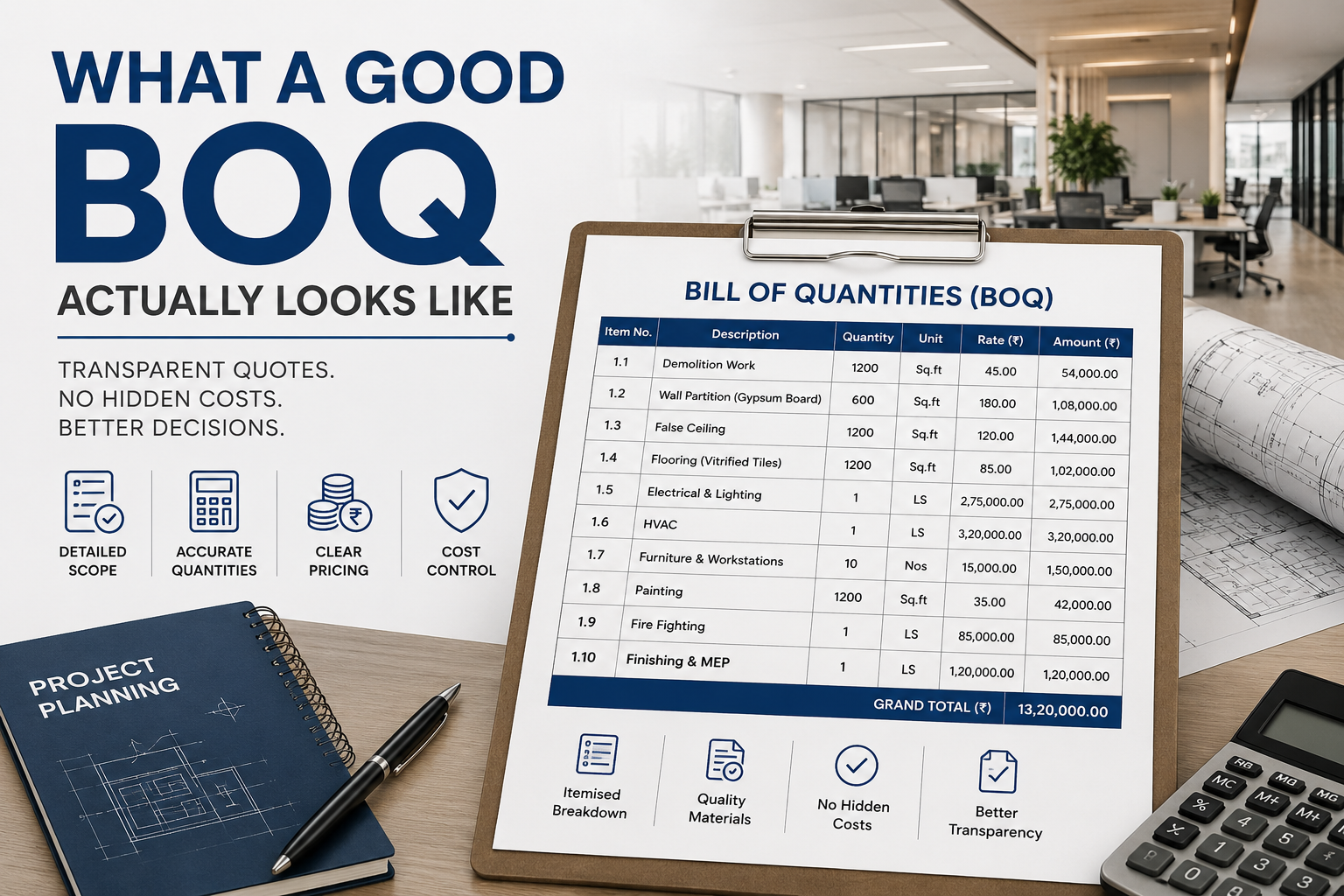
What a Good BOQ Actually Looks Like

Gaurav Chaudhary
Founder & Managing Director, Serein Spaces
A few months ago, a founder called me excited about a quote he had just received. Good number, quick turnaround, contractor sounded confident on the call. He wanted a second opinion before signing. I asked him to send over the Bill of Quantities. There was a pause on the line, and then the question I hear more often than I would like. What is a Bill of Quantities?
That pause tells me something important about how office fit-out quotes get evaluated in this country. Most business owners are comparing a single number against another single number, and calling the lower one the better deal. Nobody teaches you to ask what sits underneath that number. This blog is my attempt to fix that, at least for anyone reading it before they sign a contract instead of after.
What Is a Bill of Quantities (BOQ)?
Most people hear "BOQ" and assume it is paperwork.
It is not.
A Bill of Quantities is the itemised backbone of your project cost. Every material. Every quantity. Every rate. Written down, line by line, instead of buried inside one final number.
It is also the standard tool contractors and consultants use for cost estimation, tendering, and contract management, not something specific to fit outs. If you have ever signed a construction contract of any kind, a BOQ was likely sitting behind it.
Without one, you get a total. With one, you get a reason for that total.
That difference is where hidden costs either get caught early, or missed until it is too late to negotiate.
Why Is a Bill of Quantities Important for an Office Fit-Out Project?
An office fit out is not one job. There are several trades running at once.
Civil work. Electrical and low voltage. HVAC. Plumbing and fire fighting, where applicable. Flooring, ceiling, paint, furniture.
Each of these has its own materials, quantities, and cost drivers.
Without a BOQ, all of that gets flattened into three or four broad categories on a quotation. And broad categories are exactly where cost surprises hide.
A proper BOQ solves this in three ways I keep coming back to with clients.
It gives you a real basis to compare quotations from different contractors, line by line, not just total to total.
It gives your team and your contractor a shared, written scope of work, so execution runs on a document instead of memory. This is also what allows contractors to submit precise bids, gives you a clear benchmark for cost control, and makes it possible to track expenses against the plan as the project actually moves.
And it gives you a paper trail. If a dispute comes up later about what was or was not included in the original price, you are pointing at a document, not recalling a phone call.
Why Should Your Office Fit-Out Quote Never Be Just One Number?
A single number asks you to trust that everything was priced correctly. It gives you nothing to check that trust against.
I have seen this go wrong in fairly predictable ways.
A client assumes premium laminate is included, because a salesperson mentioned it once on a call. The written scope says otherwise. A client assumes a fixed number of electrical points per workstation. Mid execution, the quote turns out to be priced for fewer.
Never accept a quote based on price alone. There is a big difference between a cheap quote and one that actually offers good value for the money, and you cannot tell the two apart without seeing what sits behind the number.
Most of the time, this is not contractors trying to trick anyone.
It is simpler than that. A one line total leaves room for two people to remember the same conversation differently. Once work starts, that gap turns into a dispute.
A BOQ removes the room for that gap to exist. Everything gets written down, quantified, and priced before work begins, instead of argued about after it has.
What Should a Bill of Quantities Include?
A complete BOQ for an office fit-out should cover item descriptions, material and brand specifications, quantities measured against your actual floor plan, unit rates, labour costs where they are separated out, and a total for each line item that rolls up into the project total. Many BOQs also include a project timeline and payment milestones tied to specific stages of work, which is worth asking for even if it is not offered upfront.
Here is a simplified version of what a section of a BOQ might actually look like, using flooring as an example.
| Item | Description | Quantity | Unit Rate | Total Cost |
|---|---|---|---|---|
| Vitrified Tiles | 600x600mm, Grade A, branded | 1,200 sq ft | Rs 85 | Rs 1,02,000 |
| Skirting | Matching tile skirting, 4 inch | 480 running ft | Rs 40 | Rs 19,200 |
| Floor Levelling | Cement based levelling compound | 1,200 sq ft | Rs 12 | Rs 14,400 |
| Grand Total | Rs 1,35,600 | |||
A real BOQ runs to several pages once every trade is included, but this is the level of detail you should expect for each of them. If a quote you have received does not look anything like this, it is worth asking your contractor why.
How Does a BOQ Help You Compare Office Fit-Out Quotations?
Once you have a BOQ from more than one contractor, comparison stops being about the bottom line and starts being about specifics. You can check whether both contractors have specified the same tile grade, the same laminate brand, the same electrical point count, and only then decide whether a price difference reflects genuine value or a scope gap.
Here is a simple way to see how this changes the comparison.
| Comparison Point | Quotation Without BOQ | Quotation With BOQ |
|---|---|---|
| Cost Breakdown | Single total figure | Itemised by material and trade |
| Material Specification | Often vague or unstated | Brand, grade, and quantity stated |
| Ability to Compare Vendors | Difficult, based on trust | Direct, line by line |
| Risk of Hidden Costs | High | Significantly lower |
| Dispute Resolution | Relies on verbal understanding | Backed by written scope |
What Is the Difference Between a BOQ, a Quotation, and a Cost Estimate?
These three terms get used almost interchangeably, and that is part of the confusion. A cost estimate is an early, approximate figure given before detailed drawings or specifications exist, useful for budgeting but not for signing anything against. A BOQ is the detailed, itemised breakdown of materials, quantities, and rates prepared once the scope is defined. A quotation is the contractor's final commercial offer to execute the project, and in a well run process, that quotation should be built directly on top of the BOQ rather than existing separately from it.
Who Prepares a Bill of Quantities?
A Bill of Quantities is typically prepared by a quantity surveyor or an experienced cost consultant, working off finalised drawings and specifications. In a turnkey office fit-out company, this is usually done in house as part of the design to execution process, which is one advantage of working with a company that owns the full process rather than outsourcing pieces of it. If a contractor cannot tell you who prepared their BOQ or how quantities were calculated, that is worth asking about directly.
What Are the Common Mistakes to Avoid When Reviewing a BOQ?
The most common mistake I see is treating the BOQ as a formality and going straight to the total at the bottom. The second is not checking whether quantities actually match your floor plan, since a BOQ built off a template rather than your real space can quietly over or under quote entire sections. The third is ignoring the difference between fixed pricing and provisional sums, since provisional items are essentially placeholders that get finalized later, often once your ability to negotiate has already shrunk. The fourth is not asking what happens if quantities change once work begins, which is a near certainty on most sites once actual conditions are visible.
How Can a BOQ Help Prevent Hidden Costs During an Office Fit-Out?
A detailed BOQ closes most of the gaps that hidden costs come from, simply because there is very little left unstated. Before approving a BOQ, I tell clients to check the following.
- Scope of work
- Material specifications
- Labour costs
- Quantity breakdown
- Project timeline
- Payment milestones
- Warranty
- Exclusions
If any of these are missing from the document in front of you, ask for them before you approve anything. A contractor confident in their numbers will not hesitate to fill these gaps in writing.
What Questions Should You Ask Before Approving a Fit-Out Quote?
Ask who prepared the BOQ and whether quantities were measured against your actual space or estimated from a template. Ask which items are fixed and which are provisional. Ask what the process is if quantities or site conditions change once work starts. Ask for a written exclusions list, since what is left out of a BOQ often matters as much as what is included. And ask how payment milestones are tied to physical progress rather than calendar dates, so your financial exposure moves at the same pace as visible work on site.
Why Choose Serein Spaces for Transparent Office Fit-Out Quotations?
I started Serein Spaces on the idea that a client should never have to take a contractor's word for what they are paying for. Every quotation we send out is backed by a detailed BOQ prepared in house, covering civil, electrical, HVAC, flooring, ceiling, and furniture under one document, since we execute all of it under one roof rather than outsourcing pieces to subcontractors we do not fully control. If you have a quote in hand right now and are not sure whether it holds up to this level of scrutiny, I would rather you find out before you sign than after.
Planning an office fit-out? Contact Serein Spaces for a transparent quotation, detailed BOQ, and end to end office fit-out solutions tailored to your business.

