
“How long does an office interior actually take?”
It’s actually one of the first questions that comes up once you finalize a space, along with naturally so. You just want a clear office interior design timeline before you even start planning your move, hiring, or sometimes operations. However, the answer isn’t really straightforward as a single number.
An office interior isn’t all about execution on-site. Beyond that, it involves space planning, design approvals, material selections, as well as coordination across multiple teams. Each of these stages has the potential to affect how long the project really takes. Do you know? Even a small delay in one phase can shift the complete office interior design timeline.
In this blog, you’ll get a practical and realistic breakdown of its timeline, including how exactly long different office sizes take, key phases, and what really affects the overall duration.
Real Office Interior Timelines (By Size & Scope)
The interior design timeline primarily depends on how large the space is and how actually complex the preferences are. While every project is slightly different, these are realistic timelines that are based on general patterns of execution:
Timeline Breakdown
| Office Size | Estimated Timeline |
|---|---|
| Up to 1000 sq ft | 3–5 weeks |
| 1000–3000 sq ft | 5–7 weeks |
| 3000–7000 sq ft | 7–10 weeks |
| 7000+ sq ft | 10–16 weeks |
A small office generally moves faster as decisions are simpler and execution is even more direct. As the size gets expanded, more time goes into planning layouts, managing teams, along with coordinating multiple work stages such as civil work, electricals, and furniture installations.
Furthermore, it’s also crucial to properly understand that an office of the same size can still take a different time based on design complexity, material availability, and how quickly approvals take place.
Step-by-Step Office Interior Design Timeline (What Actually Happens at Each Stage)
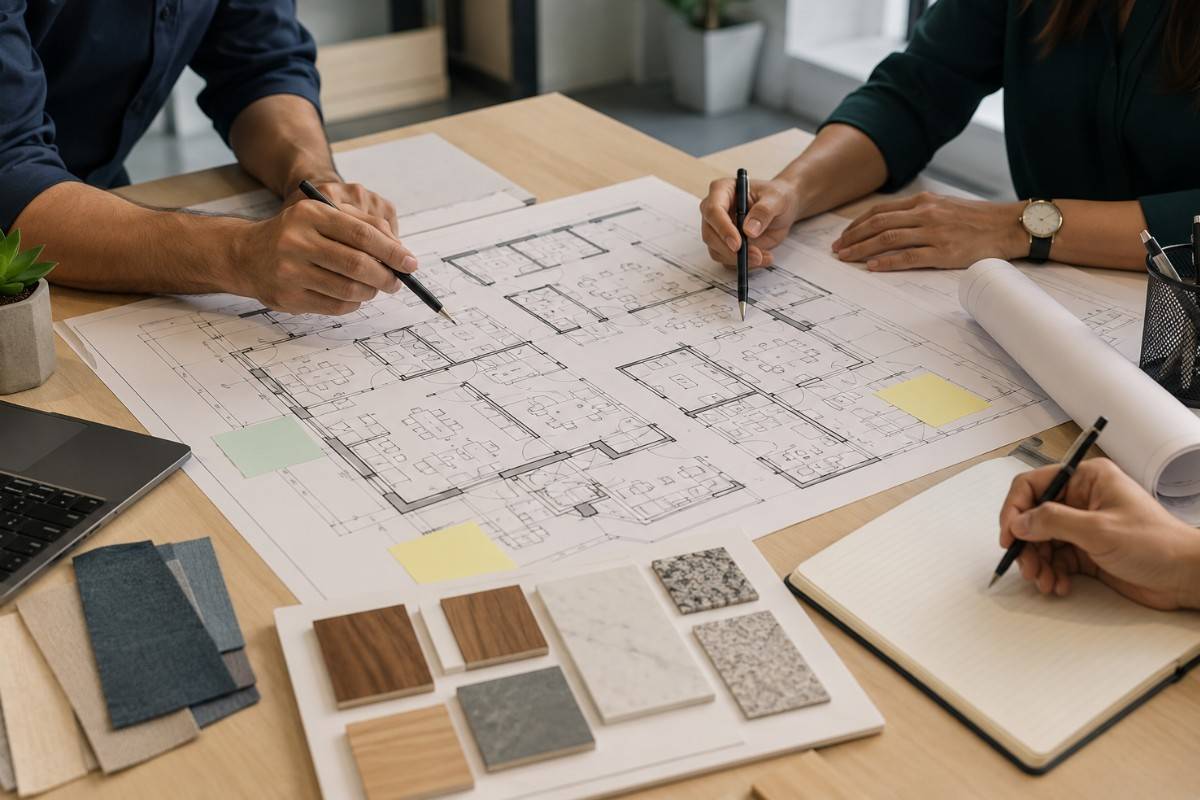
Here’s how the entire journey actually unfolds in a real project:
Phase 1: Requirement & Space Planning (3–7 days)
This is exactly where everything starts taking shape.
This is the time not to think of design. Stay on, knowing what your business does! The number of people who should occupy the space, the kind of work you have to conduct, the need for privacy, and how people should move around in the office.
Once these things are explained, the planning for the layout can start. This is where the basic layout of the office is established, including cabins, workstations, meeting rooms as well as common areas.
This is a crucial point to get right and will make the whole interior design process so much easier.
Phase 2: Design & Approval (1–2 weeks)
Now it begins to get visual.
2D layouts are very well fine-tuned, and then 3D design shows clearly how the office will look and feel. This is usually the most participatory, and feedback and revisions occur in this stage.
Small changes are ordinary, but the goal is to get it done in a good time to avoid a continual delay in execution. After it has been approved, the design becomes the blueprint for the entire project.
Phase 3: Execution (3–8 weeks)
This is the part that takes place on-site to begin the real transformation. The order of the civil works and electrical planning, installing HVAC or ductwork, ceiling work, flooring, and finally furniture and furnishing.
The phase takes the longest as there are multiple activities to be performed in sequence and sometimes in parallel. Coordinating is key here. There's no need to panic if there's any delay in materials or even in the execution itself, as it can impact the overall time frame of an interior design.
Phase 4: Final Handover (2–5 days
When the job is done, the next thing is finishing touches.
Now, this includes quality review, fixing minor errors (often it’s called snag fixing), cleaning, as well as final walkthroughs.
It's a short period, but it's crucial to make sure that everything is in working order, not just looking pretty, for daily use.
- Clear separation of focused and collaborative zones.
- Easy movement between departments.
- Avoiding wasted or unused corners
When space is planned properly, the office feels naturally organized without forcing discipline.
What Causes Office Interior Delays? (And Why Timelines Quietly Stretch)

Most of the people don’t plan for delays at the start of the office project. They think that everything is in full control until the work actually begins. And, this is where small gaps start showing up, and the office interior design timeline slightly starts slipping without even any single obvious reason.
Here’s what really causes most delays in real projects.
- Daylight where feasible.
- Light ambient lighting to be comfortable.
- Desk and work-smarter lighting.
The idea is straightforward: to alleviate tension and maintain a comfortable workspace and appearance all day long.
Multiple contractors working separately
When you handle the different parts of the project with different vendors, it makes the overall coordination a daily challenge. Here, one time waits for another to finish, and then approval moves back and forth, while responsibilities often overlap.
Even a small miscommunication between team members can pause work on-site for several days. And, this is one of the most common reasons that makes the timeline extend beyond the plan.
- Adjustable chairs with proper lumbar support
- Desks at the correct height for posture alignment
- Flexible seating for different work styles
Frequent design changes after execution starts
Changes during execution are more expensive in time than in money.
Numerous changes during execution are even more expensive in time than in money. A small adjustment in layout or sometimes material can look simple on paper, but it mostly means rework, reordering materials, or even adjusting already completed work. These changes can feel minor individually, but together they have a significant impact on the timeline.
- Soft neutrals help maintain focus
- Blues often support calm and concentration
- Green tones create a balanced, relaxed feel
Material procurement delays
The interior projects are based on the availability of materials. Many items are either custom-made or even purchased from certain suppliers, including flooring, lighting, and furniture finishes.
So, in case only one material is delayed, then it can have several dependent tasks. Ceiling work, for instance, can be postponed until lights are specified, and furniture installation can be based on the completion of the final flooring.
- Acoustic panels on walls or ceilings
- Partitioning between high-traffic zones
- Carpeted or soft flooring in work areas
Read More : Open vs. Closed Office Layouts: What Works Best
Sharing of Project Budgets that are Misaligned
When budgets are not clearly aligned right from the beginning, then the decisions are likely to shift in the middle. Sometimes, materials have to be replaced, sometimes designs are simplified, and other times approvals get delayed, and costs are reconsidered.
And, this ping-pong process slows down decision-making and directly impacts the execution speed.
Failure to Have a Structured Project Management System in Place
No matter how well-planned projects are, if there is no coordination, the momentum of the project can die down. What keeps everything aligned are the daily tracking, the sequence of tasks, and timely communication between teams.
Without this structure, some work proceeds, but not necessarily in the correct sequence, and this is not seen in the overall timeline.
- Focus zones for specified deep tasks.
- Collaboration zones for teams to discuss various topics.
- Phone or Quiet zones for calls and private tasks.
- Circulation paths that keep movement totally smooth.
A Major Fact Most People Fail to Realize
Projects operated through several completely distinct vendors are 30-50% greater likely to overrun their planned timelines, compared to projects being operated under a single coordinated system.
The reason here is just simple. Each successive layer of communication introduces time delays, and each dependency introduces the risk of a delay.
Conclusion
It is not only helpful but a clear timeline for office interior design. Then, there's its ability to keep your whole project on track. It's essential because otherwise, even basic decisions can cause delays and confusion. Serein Spaces enable clarity to start your day!
From timeline estimates to budget planning, you receive a structured plan that is based on your exact preferences. If you're also making plans to have an office, then this is the simplest way to proceed with self-assurance.


